

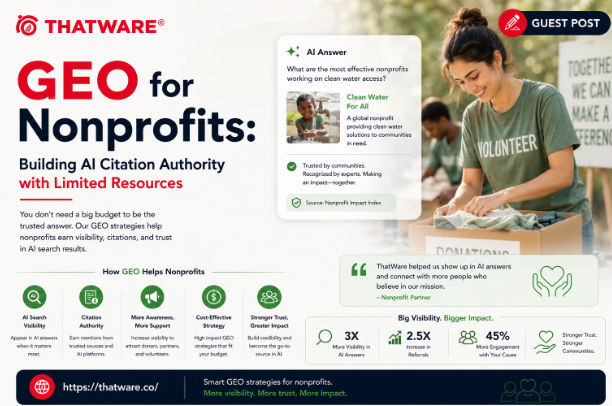
Nonprofits occupy a uniquely interesting position in the AI search landscape. On one hand, they often have genuine expertise and mission-driven credibility that AI systems tend to favor — research organizations, advocacy groups, service providers in specialized domains frequently produce the kind of authoritative, non-promotional content that earns citations. On the other hand, they typically operate with smaller content teams, tighter budgets, and less digital marketing infrastructure than the for-profit organizations competing for the same search space.
The good news is that GEO in many ways rewards exactly what nonprofits are already good at: depth of knowledge, authentic mission focus, and the kind of credible presence that comes from years of actual work in a field. The challenge is translating that genuine authority into the specific digital signals that AI systems recognize.
Why Nonprofits Actually Have GEO Advantages
Let’s start with what works in nonprofits’ favor, because it’s real and worth acknowledging.
AI systems are tuned to be skeptical of promotional content. They’re calibrated to prefer educational, informational, objective material over sales-oriented content. This means that nonprofits — whose content tends to be mission-driven and educational rather than commercially motivated — often produce material that’s naturally well-suited to AI citation.
Research and policy nonprofits, in particular, produce exactly the kind of primary source material that AI systems cite heavily. White papers, research reports, policy briefs, data releases — these are the formats that carry the most AI citation weight, and they’re the formats nonprofits often produce as their core output.
Advocacy organizations have credibility in their cause areas that commercial brands simply don’t have. An environmental nonprofit’s content about climate impacts carries authority signals that an energy company’s content about the same topic doesn’t — at least from an AI system’s perspective.
Building AI Authority Without a Large Content Budget
The resource constraint is real, but it doesn’t have to be paralyzing. The key is prioritization — focusing GEO investments on the highest-leverage activities rather than trying to compete with well-resourced commercial organizations across the board.
For most nonprofits, the highest-leverage GEO activity is making existing expertise more legible to AI systems. That means:
Turning research and program data into accessible, well-structured content that AI systems can parse and cite. A program impact report that lives as a PDF and never gets promoted is a missed GEO opportunity — the same data, reformatted as structured web content with proper schema, becomes citable material.
Building structured author profiles for organizational experts. AI systems look for named, credentialed individuals behind content. A nonprofit with a policy director who’s been working in their field for fifteen years has an E-E-A-T advantage if that expertise is explicitly represented — with bio, credentials, publications, and speaking history — rather than buried or absent.
GEO services for B2B SaaS frameworks actually translate surprisingly well to nonprofits in specialized service areas — the principle of establishing specific topical authority through consistent, expert-led content applies regardless of the organizational structure.
The Wikipedia Opportunity
For established nonprofits, Wikipedia is a GEO asset that’s worth deliberate attention. AI systems draw heavily from Wikipedia in training, and many organizations have Wikipedia pages that are thin, outdated, or don’t accurately reflect their current work and impact.
Reviewing and improving your organization’s Wikipedia presence — in compliance with Wikipedia’s conflict of interest policies, which means external editing rather than self-promotion — is one of the highest-ROI GEO activities a nonprofit can undertake. A well-sourced, accurate, comprehensive Wikipedia article about your organization contributes directly to how AI systems represent you.
For organizations that don’t have a Wikipedia article yet, the threshold for inclusion is based on “notability” — and most established nonprofits with media coverage and documented impact meet this threshold. Getting a well-sourced article created (again, following Wikipedia’s COI guidelines carefully) is worth prioritizing.
Grant Reports and Impact Data as GEO Content
Here’s an underutilized GEO opportunity specific to nonprofits: the data collected and reported for grant compliance purposes is often exactly the kind of specific, empirical content that AI systems cite.
Program outcome data, beneficiary counts, geographic impact, longitudinal results — these are the kinds of specific claims that AI systems can pull from when answering questions about social problems, interventions, and impact. Most of this data lives in grant reports that never become public web content.
A nonprofit that systematically translates its impact data into accessible, structured web content — even a simple annual impact page with clear data visualization and structured data markup — is building a genuinely valuable GEO asset from material it already has.
Coalition and Partnership Signals
Nonprofits often work in coalitions, partnerships, and collaborative programs with other organizations — including government agencies, academic institutions, and other nonprofits. These relationships are valuable AI authority signals that many organizations fail to document and promote adequately.
Being explicitly named as a partner in government agency content, academic research, or coalition documentation builds the kind of authoritative external mentions that reinforce AI model representations of your organization’s credibility and standing. Ensuring these partnerships are clearly documented on your site — and linked from partner organization sites — creates the entity relationship signals that strengthen your AI presence.
Earned Media and Third-Party Validation
For nonprofits, earned media in mainstream and specialized publications carries particular weight in AI citation authority. Being quoted in journalism about your issue area — as an expert source, not as a subject of coverage — builds the kind of contextual off-site mention that reinforces AI model representations.
Being cited in academic research, government reports, or policy documents is even more powerful. These are among the most authoritative source types in AI training data, and a nonprofit that appears as a cited source in peer-reviewed literature or government policy documents has established a level of authority that’s very difficult for commercial entities to replicate.
Best GEO agency partners working with nonprofits understand how to build these earned authority signals within the specific constraints of nonprofit communication — including the political sensitivities, funder relationship considerations, and mission alignment requirements that shape what kind of visibility is appropriate and valuable.
The nonprofits that will win at AI search aren’t necessarily the ones with the biggest budgets. They’re the ones that recognize their genuine authority and make it legible to AI systems — and that investment is often smaller than it sounds.